

What’s in a standard background check?
In short
Run an accurate criminal record database search on the wrong person and the resulting background check will be useless. That’s why identity verification comes before background checks. Learn what’s included in a standard background check below.
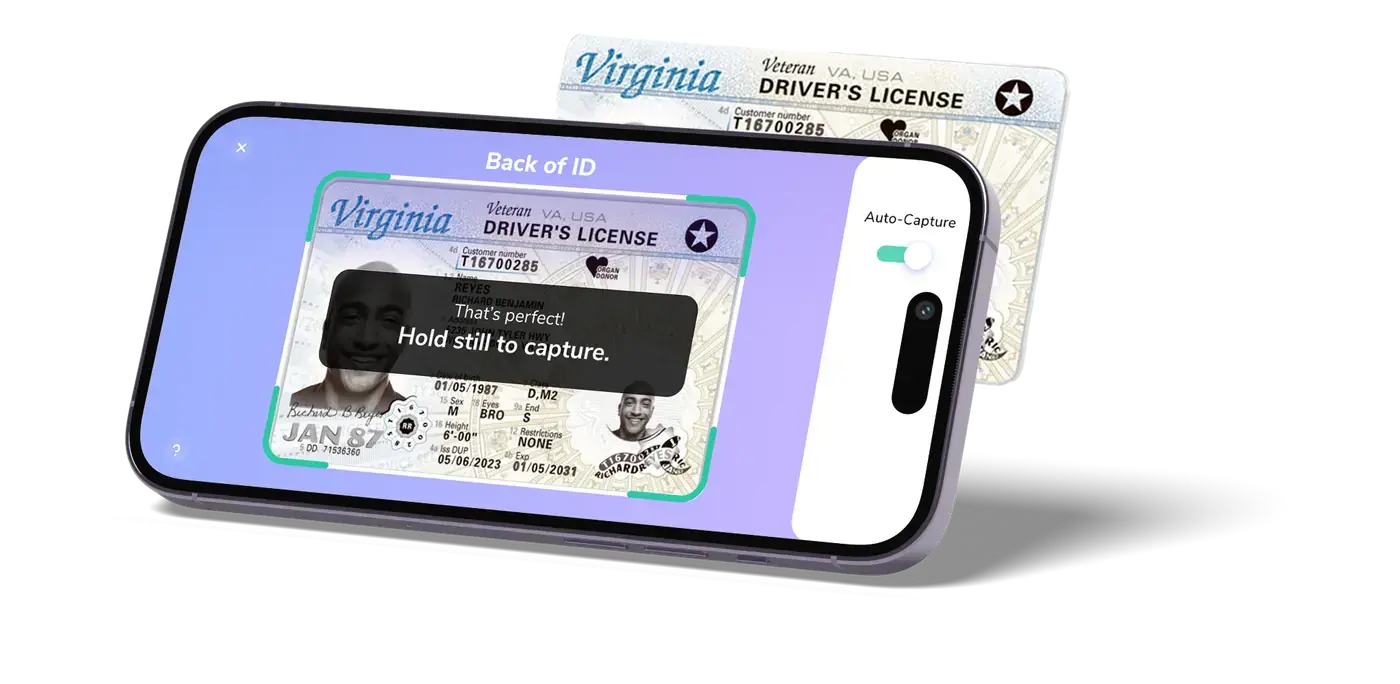
- Candidate takes a photo of their ID card and submits a selfie
- Identity data gets pushed to background searches
- Get the report in minutes when no further review is needed
The standard vID background check includes national criminal and sex offender searches and an SSN address/alias trace. Criminal history is matched against candidate identity using dates of birth, Social Security Numbers, addresses, driver’s licenses, mugshots, and more. Learn more about identity-first background checks below.
Step 0: Get your candidate’s consent
Employers should review the Federal Trade Commission’s Using Consumer Reports: What Employers Need to Know resource, which explains disclosure and authorization requirements. Background checks used in employment decisions are “consumer reports” under the Fair Credit Reporting Act (FCRA), which means:
- Provide your candidate with a clear and conspicuous disclosure that a consumer report (background check) will be requested and get their written authorization. This document should stand alone; candidates should not be buried in additional agreements when consenting to a background check.
- Certify to the consumer reporting agency (CRA) that you’ve followed these steps.
- If you’re considering making an adverse decision based in whole or in part on the background check (aka: pre-adverse action), provide your candidate a copy of the report and A Summary of Your Rights Under the Fair Credit Reporting Act prepared by the Consumer Financial Protection Bureau before taking adverse action. Learn more in the FTC’s adverse action guidance.
- Once you’ve taken adverse action, provide the candidate the CRA’s name, address, and phone number, a note that the CRA did not make the decision and cannot explain it, and notice that candidates can dispute the report’s accuracy or completeness and request another free copy from the CRA within 60 days. Learn more in the FTC’s adverse action guidance.
State background check laws may impose additional requirements.
Using Consumer Reports: What Employers Need to Know. Disclosure, authorization, CRA certification, and the notices required before and after adverse action.
Step 1: Verify their identity
vID begins with identity verification, confirming candidates’ identity with NIST Special Publication 800-63A compliant identity proofing before running the following searches. Candidates take a photo of their government-issued ID and submit a selfie. These artifacts are used to confirm candidates are (a) using a real ID belonging to (b) them. Learn more.
SP 800-63A: Identity Verification. NIST describes linking validated identity evidence to the live person presenting it.
Step 2: Get their info once, use it everywhere
Identity data gets pushed to the rest of the background check, reducing errors introduced when candidates have to provide the same data over and over. Learn more.
What’s included in vID’s $25 Background Check
The standard vID background check includes national criminal and sex offender searches and an SSN address/alias trace:
National criminal search
Searches compiled county, state, and other jurisdictional criminal record sources for felony and misdemeanor convictions. County-level criminal cases are the most complete source of criminal cases originating in that county, so if something potentially matching a candidate turns up we’ll follow up for courthouse confirmation via TazWorks, with more on turnaround times below.
Enforcement Guidance on the Consideration of Arrest and Conviction Records in Employment Decisions under Title VII. Section III.A describes criminal-record sources and the role of county courthouse records.
National sex offender search
Searches the Department of Justice’s Dru Sjodin National Sex Offender Public Website for the candidate’s name and any other identifying information.
About NSOPW. The Department of Justice explains the national public-registry search.
SSN address/alias trace
Compiles address and alias history using the candidate’s Social Security number. This is not a credit check or employment-eligibility check. It is used as a tool to identify criminal case candidates.
Our parent network, Cerebrum, connects employers with 28 trusted background check providers. Searches are aggregated and matched using Synapse, Cerebrum’s identity matching technology, which uses identity data collected during identity verification to match records. Criminal history is matched using dates of birth, Social Security numbers, addresses, driver’s licenses, mugshots, and more. We even match candidate selfies to criminal mugshot databases. Learn more.
The more information available to match, the more accurately we can tie criminal history to the right person. Some results are obvious matches and some aren’t, which means we escalate ambiguous cases to a team of human analysts or ask courthouses directly for confirmation. We’ll never automatically clear records that aren’t an exact match. Learn more.
vID’s pay-as-you-go background checks are $25 with no subscription. We’ll never sacrifice courthouse confirmation or ignore restricted records to reduce turnaround times, but turnaround times vary accordingly. Some cases will clear in minutes and some will take days. Learn more.
Need more than a standard background check? Check out Cerebrum for additional components and trusted, PBSA accredited CRAs.
Final decisions are left up to the employer. We will simply make sure we are handing you facts about the right people. Learn more.
How do vID’s Background Checks work?
Background Checks
Run the most accurate background checks possible – start with identity verification
Imagine pulling up accurate background check results for the wrong people. What’s the point of getting results quickly if you can’t trust them? That’s why vID starts every background check with identity verification. We collect identity information within our verification processes, reducing re-keying of sensitive information. Then we use this verified identity for all of a candidate’s background check components. This gives you peace of mind that search results actually relate to your candidate.
Here’s a breakdown of our pay-as-you-go Background Checks product (no subscription required):
Our most popular check for $25: Standard Background Check:
 Identity Verification – candidate’s government-issued ID and selfie (see above)
- National Criminal Search – searches for criminal records across many states and counties using candidate’s identity information from Identity Verification. This includes name variants to increase accuracy and mitigate missed results that can occur with searches limited to candidate’s current name/address.
- National Sex Offender Search – searches for records from the Dru Sjodin National Sex Offender Public Website (NSOPW). This website aggregates sex offender registry info from all 50 states, DC, U.S. territories, and participating tribes. Results should always be verified with specific jurisdictions as NSOPW notes: The accuracy of the website’s information depends on the accuracy of the information provided by states and territories.
- Social Security Number Trace – provides names and address history associated with the candidate’s SSN to improve criminal search results
Dru Sjodin National Sex Offender Public Website fact sheet. NSOPW links registries in all 50 states, D.C., U.S. territories, and participating tribes. Confirm results with the contributing jurisdiction.
Plus Background Check: everything in the Standard, plus:
- County Criminal Search (past 7 years) – searches directly from the courthouse or another authoritative source to confirm criminal records. County-level criminal searches are critical to ensure accuracy – they help verify records found or not found during National Criminal Searches to check for inaccurate, outdated, missing, or incomplete records, including disposition. A January 2024 advisory opinion from the Consumer Financial Protection Bureau discussed reasonable procedures to keep inaccurate public records, such as sealed, expunged, legally restricted, or duplicate records, out of consumer reports. The CFPB withdrew that advisory opinion on May 12, 2025.
Fair Credit Reporting; Background Screening (advisory opinion). The January 2024 background-screening opinion is retained here as a historical reference.
Withdrawn Guidance. The CFPB lists the May 12, 2025 withdrawal of the background-screening advisory opinion.
Other common check types – Employment Verification, Education Verification, Drug Screening, Motor Vehicle Records, Continuous Monitoring, etc. – are available à la carte depending on your employees’ job functions and use cases. Learn more in our Background Checks guide.
The process
- Employer starts a Background Check for a candidate.
- Candidate completes an Identity Verification, allowing us to collect critical identity information directly in our platform.
- We use candidate’s verified identity to perform SSN Trace and other searches.
- We use the most up-to-date and comprehensive databases to perform these searches, ensuring high-quality, actionable results for employers.
- SSN Trace and National-level searches occur through Cerebrum, a background check network with 28 providers
- Criminal record matches are identified through Cerebrum’s Synapse solution
- County-level confirmations occur through TazWorks
All of our Background Checks occur through screening partners that adhere to rigorous standards for performing consumer reports in the U.S. Our partners are accredited by the Professional Background Screening Association (PBSA), which conducts periodic reviews of our partners’ processes. We’re committed to complying with the highest quality and ethical standards for background checks. Learn more about background check best practices from the Federal Trade Commission’s Using Consumer Reports: What Employers Need to Know guide.
PBSA Accreditation Program. PBSA’s accreditation program reviews screening organizations and their processes.
Employer responsibilities
Employers are responsible for complying with Fair Credit Reporting Act (FCRA) regulations around background checks (aka “consumer reports”). Learn more in the CFPB’s A Summary of Your Rights Under the Fair Credit Reporting Act and the Equal Employment Opportunity Commission’s 2012 enforcement guidance on arrest and conviction records. It’s critical for employers to implement criminal history policies that minimize disparate treatment and disparate impact on protected classes. An arrest does not necessarily indicate criminal behavior. Convictions should be assessed using Green factors, which consider the nature and gravity of the criminal offense, time that has passed since the offense and/or completion of the sentence, and the nature of the job at hand. Some employers implement individualized assessment processes. Remember, a criminal history is a factor, it is not meant to be used as an automatic rejection.
Enforcement Guidance on the Consideration of Arrest and Conviction Records in Employment Decisions under Title VII. The EEOC discusses arrests, convictions, the Green factors, and individualized assessment.
Ready to learn more about vID’s digital identity verification platform? Start a $25 Background Check at /start or contact us.
Additional reading: NIST Special Publication 800-63A describes linking validated identity evidence to the physical person presenting it. Identity verification can be used in background checks to mitigate this risk.
SP 800-63A: Identity Verification. Additional reading on identity proofing and verification.